Verizon outage exposes fragility of mobile connectivity as users nationwide report service loss
A widespread Verizon network outage disrupted calls, texts, and mobile data across the U.S., with many customers reporting “SOS” indicators and large spikes in outage complaints.
- BYLINE
- Lagos Tribune News Desk
- PUBLISHED
- UPDATED
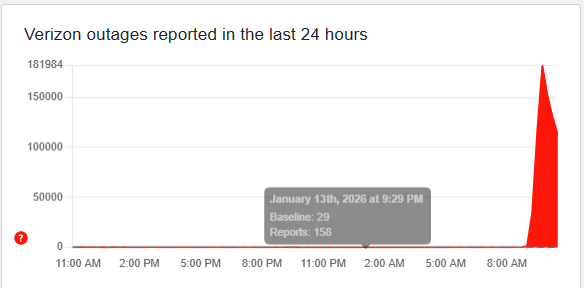
A large Verizon network outage in mid-January highlighted how quickly connectivity failures can ripple across everyday life and critical services. Customers across the United States reported losing wireless voice, messaging, and mobile data, underscoring the dependence of households and businesses on uninterrupted mobile networks.
Outage reports surged on incident-tracking platforms, and many users said their phones displayed “SOS” or “SOS only,” a signal state that indicates limited connectivity for emergency access while normal carrier service is unavailable. Complaints spiked across multiple metro areas, suggesting a broad geographic impact rather than an isolated regional failure.
Verizon acknowledged the issue publicly as engineers worked to identify and resolve the disruption, but the immediate cause was not clearly described in initial communications. For customers, the lack of certainty about timelines and scope compounded the practical impacts, especially for people relying on cellular data for navigation, work, and two-factor authentication.
Service interruptions can be particularly disruptive for small businesses and distributed teams that depend on mobile hotspots, field communications, and app-based dispatch. Even short disruptions can delay deliveries, interrupt customer support, and trigger cascading authentication problems when logins and security codes fail to arrive.
The outage also renewed attention on resilience strategies: device-level fallback options like Wi‑Fi calling, carrier redundancy for critical operations, and clearer public messaging during service degradation. In emergencies, the public’s expectation is not only that service will return quickly, but that they will receive accurate information about what works and what does not.
As mobile networks increasingly serve as the default communications layer for consumers, outages have become more than inconveniences; they are moments that test infrastructure redundancy, incident response, and trust. The Verizon disruption served as a reminder that network reliability is now a core part of national and local continuity planning.
With continued reliance on mobile connectivity for banking, healthcare, travel, and workplace coordination, the incident is likely to feed broader conversations about transparency, investment in reliability, and customer protections during large-scale network failures.